The beginnings of a technology that changed everything
At the turn of the 1970s and 1980s, the first devices appeared that can be considered prototypes of modern insulin pumps. One of them was the AutoSyringe system – an experimental solution allowing continuous insulin delivery.
The device was far from today’s compact pumps. It weighed about half a kilogram (close to one pound), was worn on a belt, and delivered insulin through a thin tube ending with a needle placed under the skin of the abdomen. Insulin was administered automatically every few minutes, which allowed much better glucose control than with traditional injections.
Patrick Connolly – a pioneer of modern therapy
One of the first users of this solution was Patrick Connolly, an Associated Press reporter from Seattle. He had lived with diabetes for 27 years and during that time had taken – as he himself emphasized – more than 10,000 insulin injections.
In the photo taken by Associated Press, we see Connolly adjusting a pump attached to his belt. The original caption of the photograph gives the date December 18, 1986; however, this is incorrect – Connolly had already died in 1984. Most likely, the photo was taken earlier, between 1978 and 1984.
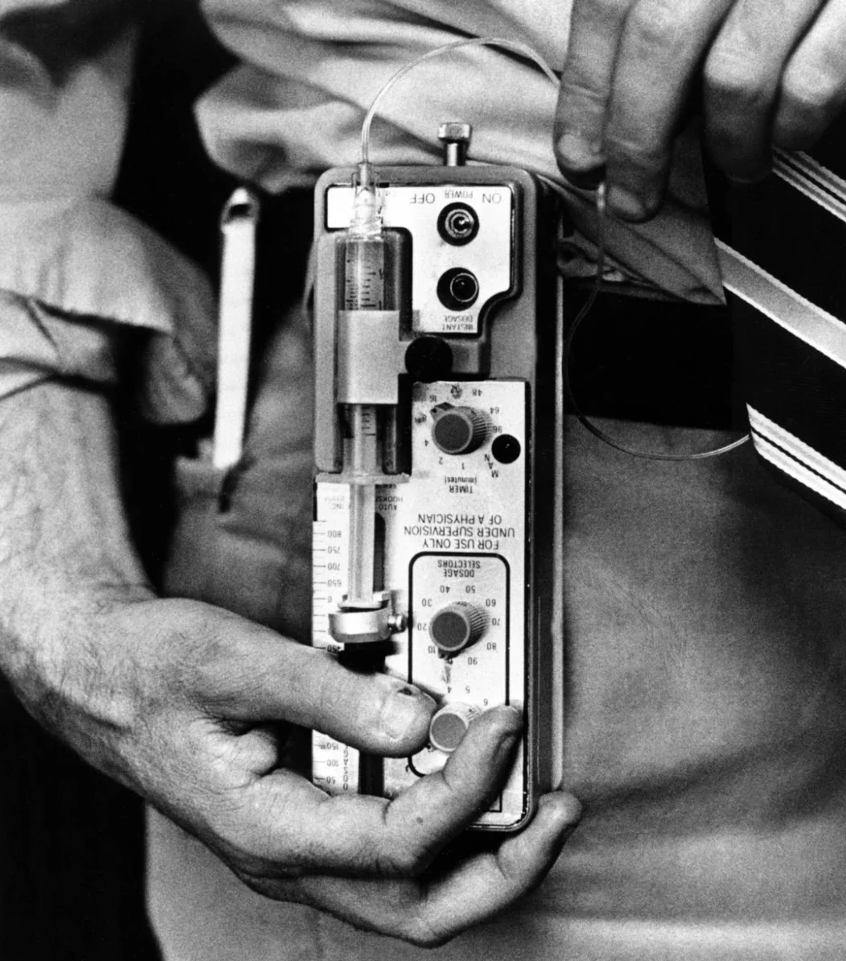
For Connolly, AutoSyringe was not just a technological gadget – it was a real improvement in quality of life. The device made it possible to keep blood sugar levels closer to normal and reduce the need for constant injections.
How did AutoSyringe work?
Although today insulin pumps are advanced computers, the first models were relatively simple:
they delivered insulin in constant, small (basal) doses,
they did not have advanced algorithms or glucose sensors,
they required manual adjustment,
they were large and inconvenient for everyday use.
Despite these limitations, they represented a huge step forward – for the first time it was possible to mimic the natural function of the pancreas continuously rather than in spikes.
Significance for modern diabetology
AutoSyringe and similar devices initiated the development of technology that today includes:
modern insulin pumps,
CGM systems (continuous glucose monitoring),
closed-loop systems (the so-called “artificial pancreas”).
What was once an experiment worn on a belt now fits in a pocket and works together with a smartphone.
Final reflection
The story of Patrick Connolly shows how enormous progress has been made in diabetes treatment over just a few decades. It is thanks to pioneers like him that it was possible to develop technologies that today save health and improve the quality of life of millions of people around the world.
AutoSyringe may look like a relic of the past today, but without it, the modern solutions we use every day would not exist.