An Insulin Pump with an MP3 Player? Bigfoot Biomedical's Strange Patent
Imagine your insulin pump has a built-in MP3 player. You can plug in headphones and listen to music straight from the device that delivers your insulin. And on the screen, the song title appears - let's say Van Halen's "Cabo Wabo" from 1988.
It sounds like a joke. Yet it was a real patent.
Diabetes article series:
Tandem t:slim X2 Pump - when a medical device resembles an iPhone
Discretion Has Value - how insulin pens protect against stigmatization
Pens and pumps: how diabetes technologies hide their medical face
The NovoPen from 1986 - how a fountain pen changed diabetes care
The 2012 Patent
Bigfoot Biomedical, now associated with work on the artificial pancreas and insulin pump hacking, filed a patent in 2012 titled "Portable Infusion Pump and Media Player". It was approved in 2016 (US Patent 9,314,566 B2).
The application states: "In particular embodiments, the portable infusion pump system can serve a dual purpose of providing medication and entertainment for the user from a compact and unobtrusive device". The pump was supposed to have a hard drive, a headphone jack, and an interface for playing music. Everything in one device.
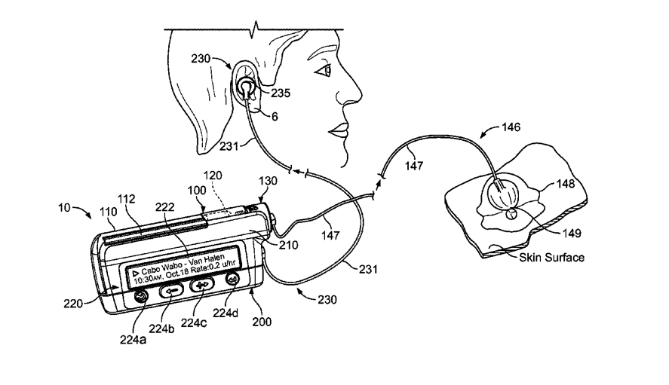
The patent drawing (the figure above from the article by Rentschler and Nothwehr) shows a user with a pump clipped to a belt and headphones plugged into the device. In the background, the Van Halen band name and the song title "Cabo Wabo" are clearly visible. This is no random decoration. The designers reveal their musical tastes and their idea of the user: a classic rock fan, active, and keen on independence from a smartphone.
Rentschler and Nothwehr comment on it with irony: "revealing something of the designers' taste culture and their imagination of who their users might be: fans of the band Van Halen". Accurate.
Why Didn't It Reach the Market?
Bigfoot Biomedical did not bring this device to market. Most likely for several reasons:
Safety. Distraction while administering insulin is a risk. Someone might not hear a pump alarm because they were listening to music
Additional cost. A pump is already expensive (USD 6000), and adding more functions pushes the price up
Limited demand. People with diabetes prefer listening to music from a phone. They carry a phone anyway, so why duplicate functions?
Still, the patent itself is interesting. It shows how manufacturers imagine the user, and how far the logic of making a pump resemble a lifestyle device can go.
Context - Bigfoot Biomedical and the DIY Artificial Pancreas
It helps to remember that Bigfoot Biomedical was not some random company. It was founded by Bryan Mazlish, who hacked an insulin pump so it would work as a closed loop system, the so-called artificial pancreas. His son and wife have type 1 diabetes. Bigfoot is known for its DIY approach and for automating the human work involved in diabetes management.
The company's website states: "In the right circumstances, a machine can by and large make better decisions than humans if given the appropriate information and direction. Unlike people, machines never tire, never get distracted". That is a radical position. In a sense, it fits the pump-MP3 idea: the machine could deliver insulin and provide entertainment too.
My Take on This
I think this is a conceptually interesting idea that is completely impractical. We do not need a pump with MP3. We need a pump that works reliably, is comfortable, and does not stigmatize. Bigfoot Biomedical went in a very different direction. That is a pity, because the company had potential - but this shows it did not always choose its ideas well.
As a side note, the choice of Van Halen as a cultural reference also says a lot. The designers clearly seem to come from the generation that grew up in the 1980s. No wonder their imagined user is someone listening to "Cabo Wabo". The problem is that diabetes also affects young people who may have no idea who Eddie Van Halen was. In a way, today we do have MP3 and a pump almost in one - because a smartphone often acts as the pump remote, and today's smartphone is a multimedia hub. With Nightscout support too!