This post will be different. Sad.
Because sometimes we need to set aside technological marvels, announcements of breakthrough sensors, and investor presentations for a moment. And face the truth. The diabetes epidemic is not slowing down. If the data is to be believed - it is accelerating.
Dexcom's Investor Day 2026 materials show a company with a plan, a product, and money. But the same slides, read more carefully, tell another story too. A story of a system that cannot keep up. And of millions of people falling into this disease before anyone manages to react.
A wave you do not see until it hits
Let's start with the numbers. Globally, according to the International Diabetes Federation (IDF), as many as 589 million adults were living with diabetes in 2025. One in nine adults on this planet. And one in four Americans has prediabetes. In the United States alone, over 40% of adults are in this gray, treacherous zone that may, or may not, turn into full-blown disease. And it is precisely there, in this huge, silent group, that Dexcom sees its biggest market. Not for sensors that save lives from hypoglycemia, but for Stelo - a product meant to be a window into the world of "healthy" people who, in reality, are not healthy at all.
And in Poland? The data is even more alarming. Our country is recording the fastest increase in type 1 diabetes incidence in Europe, especially among children. According to experts, one in 200-250 children is already affected. At the same time, type 2 diabetes affects more than 3 million Poles, and another 5 million have prediabetes. These numbers are no longer just statistics - they are everyday reality playing out in pediatric wards, primary care offices, and homes where parents learn how to give insulin to their child.
Why is this happening?
The Dexcom presentation lists three main factors driving the epidemic:
Population aging - every year there are more older people, and diabetes is most common in this group. On top of that, we live longer, but not necessarily healthier lives
Lifestyle - obesity, lack of exercise, and diets rich in processed foods are factors that have dominated daily life for millions of people over the past three decades
Lack of awareness and late diagnosis - this point connects directly with Dexcom's business model. The company openly admits that its "addressable market" - meaning people who have insurance but do not yet use CGM - is more than 9 million people in the US. Millions more are completely unaware of their disease.
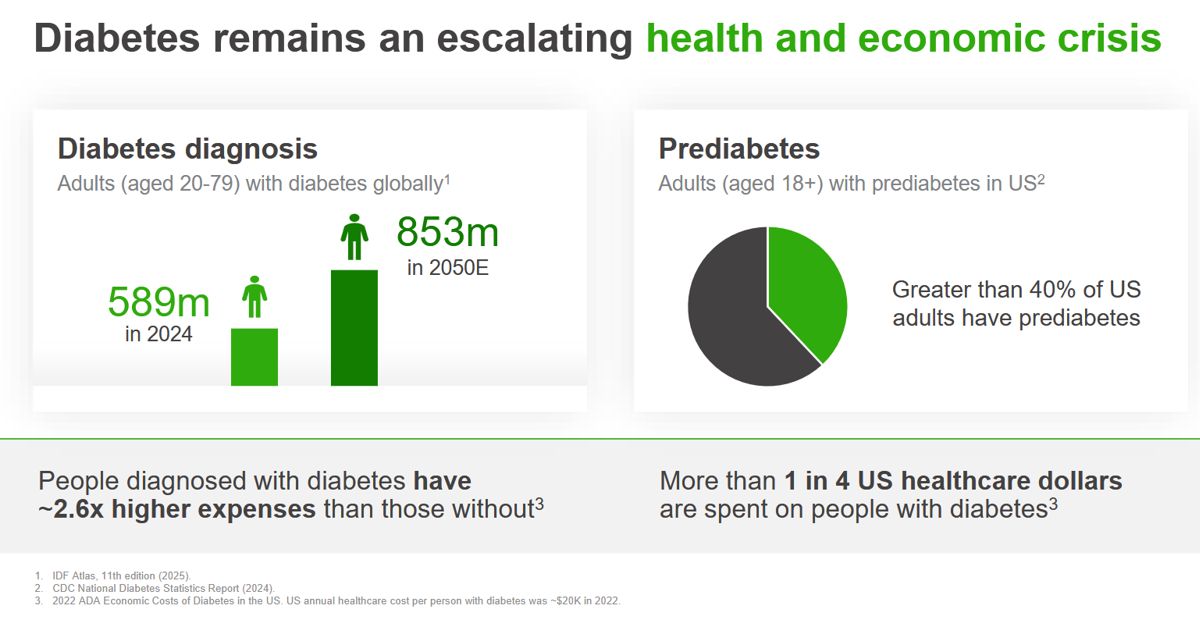
In the slide above, Dexcom shows the data that should worry us most. People with diabetes have 2.6 times higher healthcare costs than people without diabetes.
More than 1 in every 4 dollars spent on healthcare in the US goes toward treating people with diabetes. This is no longer just a medical issue. It is a financial drain on the entire system.
The sad paradox
Dexcom talks about the "health and economic outcomes" its product is supposed to generate. Stelo is meant to help people with prediabetes avoid full-blown disease. Smart Basal is meant to optimize insulin therapy for people with type 2 diabetes before their glucose spins out of control. All of that is true. And all of it works - for those who have access to these technologies and know how to use them.
But the system is bursting at the seams. Not because tools are missing. Because the wave of new cases is growing faster than any company, government, or healthcare system can respond.
Dexcom talks about "more than 9 million people in the US who have reimbursement and still do not use CGM". For investors, that is an opportunity. For me - proof that even where technology is available and paid for, people are not reaching for it. Why? Lack of education? Fear of technology? Or maybe simple exhaustion from a disease that takes too much time and energy?
Conclusions that offer no comfort
The diabetes epidemic has no simple solution. Dexcom will show the G8, Abbott will release a new Libre sensor, Medtronic will release a new insulin pump model, and someone else will offer a multi-analyte sensor. All of that will help. But it will not stop the wave. Stopping the wave would require something no company can sell. It would require lifestyle change on a mass scale. It would require nutrition education starting in preschool. It would require cities designed for people, not cars. It would require agricultural policy that does not promote cheap sugar in every processed food. Or maybe it would require changing something else as well? And why are children developing type 1 diabetes so quickly and so often?
Will this happen? I do not see it on the horizon (yes, even though I am optimistic by nature). What I do see is more millions of people joining that 589-million figure every year. And I see companies like Dexcom making money from it. There is nothing wrong with that - they are not personally responsible for stopping the epidemic. But the sad part is that they often seem to be the only ones who even recognize its scale.
Sources: Dexcom Investor Day 2026 presentation; IDF Diabetes Atlas 11th edition 2025; Polish Diabetes Association data (2025); NFZ report "Diabetes in Poland 2025".