Before the smartphone: the insulin pump as a pager (the AutoSyringe story)
Today’s insulin pumps are often compared to smartphones. A dozen or so years ago, they were compared to pagers. And even earlier - to nothing, because there were no such comparisons. The first pumps looked exactly like what they were: medical experiments.
Rentschler and Nothwehr devote a lot of space to the history of pump design. That matters, because it shows design is not neutral. Every era produces its own kind of "pretending."
AutoSyringe - the first pump
Dean Kamen (the same person who later invented the Segway) patented AutoSyringe in the mid-1970s. In fact, two patents: one from 1973 for a "medication injection device," and another from 1974 for a "control device for a monitor supervising a patient." In 1976, he founded AutoSyringe, Inc. to bring these designs to market.
What was it? A simple syringe with a small motor, enclosed in a plastic box. You could see the syringe from the outside. It didn’t hide its medical purpose. In a photo from 1978-1984 (Associated Press), reporter Patrick Connolly is shown wearing the pump clipped to his belt. Connolly, who had lived with diabetes for 27 years, wore this experimental device. The pump weighed about half a kilogram. Today’s pumps weigh 50-80 grams.
Connolly died in 1984. His photo with the pump circulated worldwide. It remains one of the defining images of early pump-based insulin therapy.
The pager era
Over time, manufacturers realized the medical look didn’t sell well. They needed to hide the syringe and the motor. That’s how pumps modeled after pagers appeared - small, rectangular, with a screen and buttons, worn on a belt.
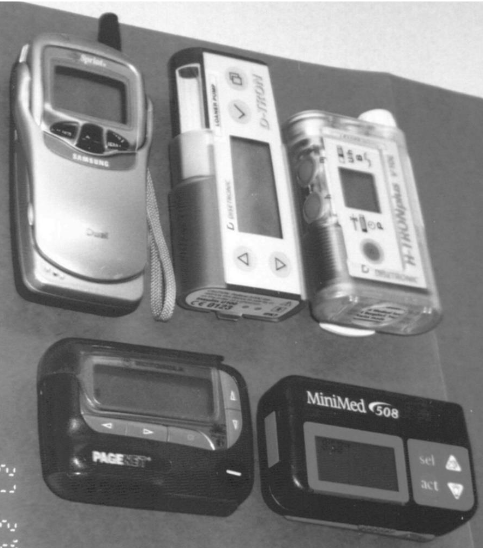
The MiniMed 508 (late 1990s) and the Motorola PageNet pager (around 2001) are almost indistinguishable. The same goes for the Disetronic H-Tron Plus (approved in the US in 1991) and earlier models. In one photo from a 2001 article, you can see four devices: two pagers and two pumps. It’s genuinely hard to tell which is which.
Rentschler and Nothwehr write: "Visual juxtapositions draw a direct association between these insulin pumps and the design of iconic telecommunication technologies of the time." Manufacturers didn’t hide this inspiration. They leaned into it.
Why a pager?
In the 1990s and early 2000s, the pager was a symbol. It signaled a fast-paced life, business, professionalism. You wore it on your belt or kept it in your pocket - just like a pump. It beeped, vibrated, demanded attention. So does a pump.
Manufacturers exploited that association. In patient education materials (for example, UC San Francisco Diabetes Education Online), you can still read: "insulin pumps are the size of a pager, and fit in your pocket." Canadian and British diabetes associations use the same comparison.
The problem is that pagers are now a vintage curiosity. They’re sold on eBay as props, not as functioning devices. Yet pumps still often look like pagers. That’s not innovation. It’s stagnation.
My opinion
I think pump manufacturers have coasted for far too long. The pager comparison worked 20 years ago. Today it feels dated - especially to younger users who have only seen pagers in movies.
Fortunately, new designs are starting to appear (more on that in the next parts of this series), but the pace of change is frustratingly slow. Most pumps on the market still look like devices from the late 1990s...
Previous posts in this series:
Discretion comes at a price - how insulin pens protect against stigmatization
AutoSyringe - the beginnings of insulin pumps and a story that changed diabetes treatment
Pens and pumps: how diabetes technologies hide their medical nature
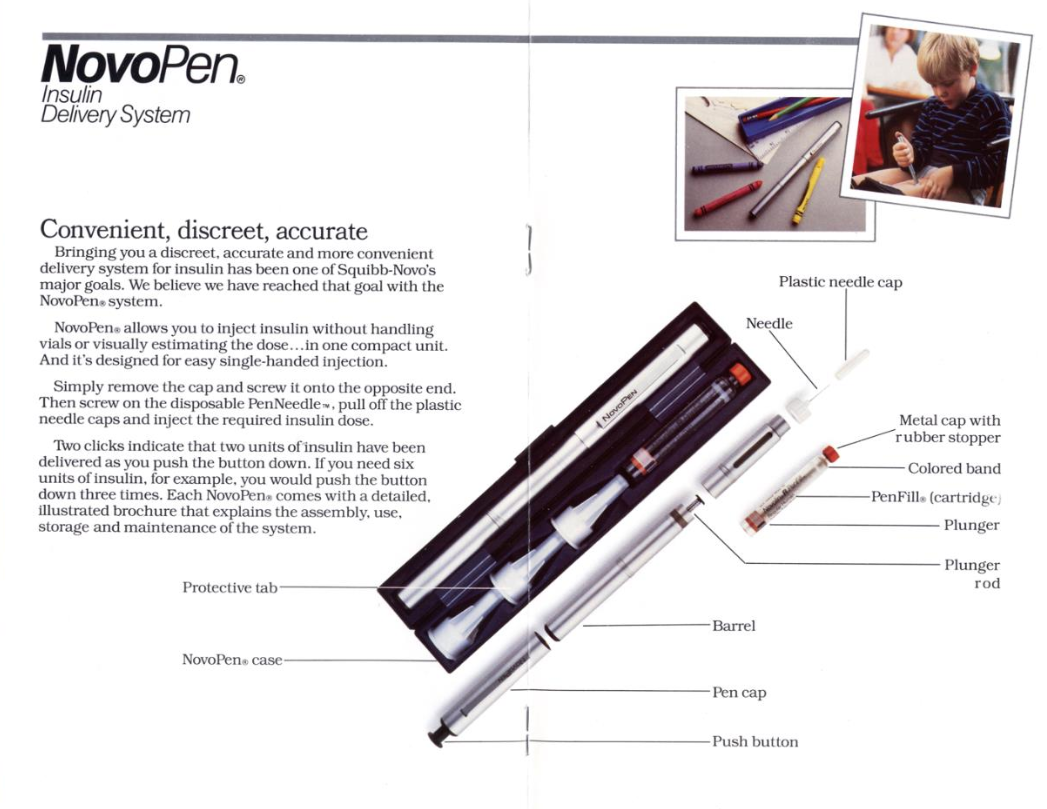
The NovoPen from 1986 - how a fountain pen reshaped diabetology
Diabetes as performance - living under social and medical surveillance